

When I first wondered what people in Monaco do for a living, I pictured one very specific scene: everyone in sunglasses, gliding off superyachts, casually checking their diamonds the way I check my pockets for my keys.
And yes, there are yachts and diamonds. Plenty of them. But that’s only the glossy postcard.
If you and I were sitting together in your favorite chair, tea in hand, I’d tell you that behind every glamorous photo of Monaco, there’s a surprising amount of very normal work happening. Accounting. Teaching. Construction. Office jobs. Bus driving. People cooking breakfast in hotel kitchens before the sun even rises over the harbor.
Monaco is tiny, smaller than many neighborhoods, but its economy is like a well‑packed jewelry box: every inch is used, and almost nothing is random. As I dug into how this little principality actually functions, I found stories and jobs you’d happily retell to your friends: the banker who commutes from France, the teacher who hears six languages at recess, the mechanic who only works on cars most of us will only ever see on TV.
Let me walk you through it, piece by piece, so that by the time you finish reading, you’ll be able to answer, with a small smile, when someone asks, “So what do Monaco people even do all day?”
Article at a Glance (If We’re Being Honest)
-
Monaco’s economy revolves around money, property, service, and precision, but the work behind it is often quieter and more ordinary than the image suggests.
-
Banking, real estate, hospitality, retail, events, and public services all coexist in an extremely small space, creating a dense and unusual working rhythm.
-
Many of the people who keep Monaco running don’t live there, commuting daily from nearby France and Italy.
-
Languages matter. So do discretion, reputation, and knowing how to move comfortably in international environments.
-
Behind the yachts and headlines is a city held together by teachers, nurses, planners, cleaners, technicians, and office workers who rarely appear in photographs.
A Different Way to Look at Monaco’s Working Life
Monaco’s job market isn’t just unusual because of how much money flows through it. It’s unusual because of how compressed everything is.
In just over two square kilometers, you’ll find private banks managing enormous fortunes, construction crews carving new space out of rock and sea, hotel kitchens waking before dawn, luxury shops opening their doors with quiet precision, and public workers making sure the whole place stays clean, safe, and functional.
It’s a place where extremes live side by side.
A banker and a bus driver might pass each other on the same narrow street.
A yacht broker and a nurse might ride the same early train home.
For outsiders, Monaco often looks like a self-contained world of wealth. In reality, it’s a carefully balanced system that depends on thousands of people doing very real, very human work every day — often out of sight.
This article isn’t about how to get a job in Monaco, or how to optimize a career there. It’s about understanding what kind of work actually happens, who does it, and how the principality functions once you look past the postcard.
If you’ve ever wondered what keeps Monaco running when the champagne glasses are empty and the yachts are quiet, you’re in the right place.
Let me show you.
Who Actually Lives And Works In Monaco
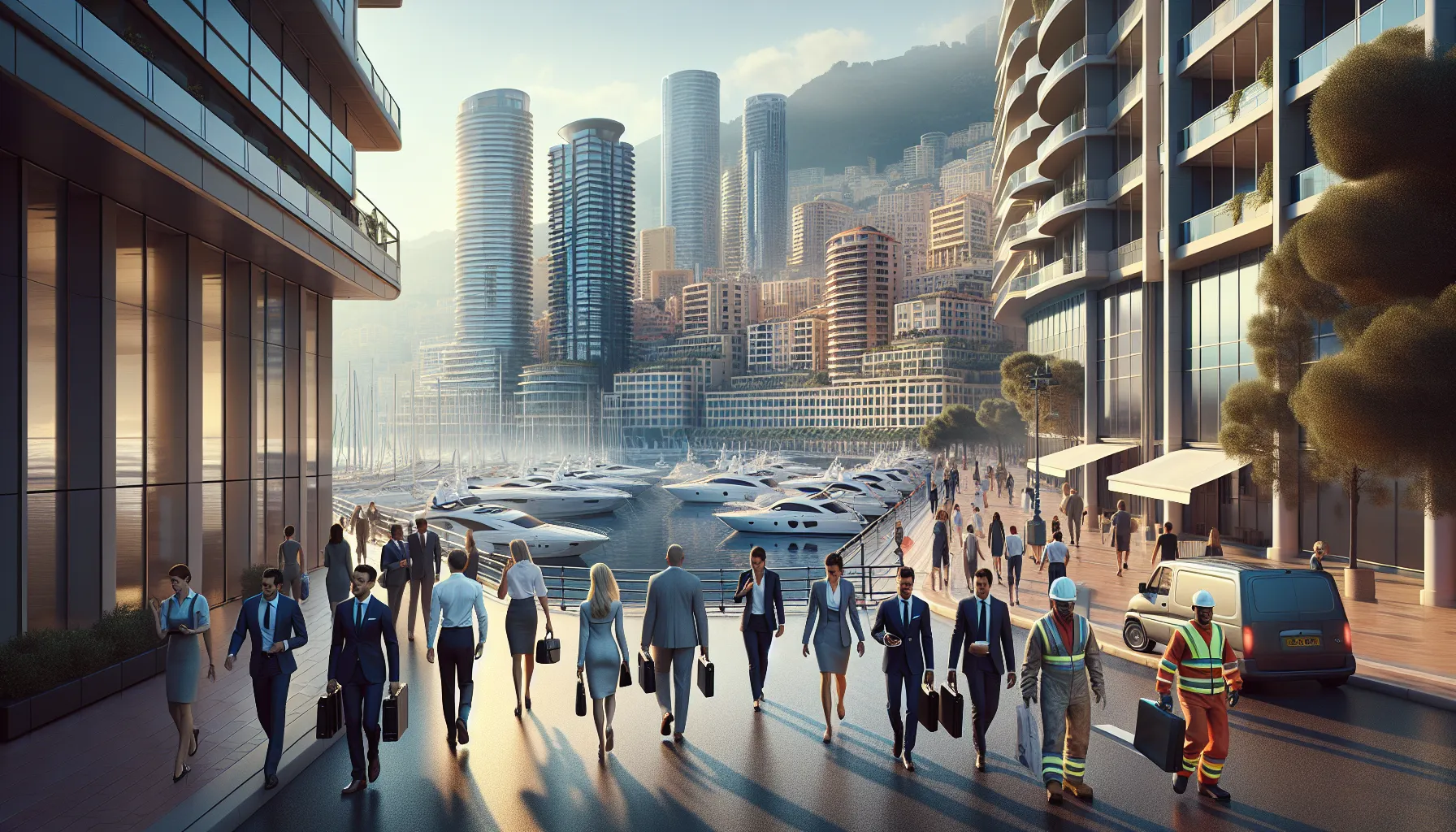
When people think of Monaco, they often imagine it’s full of movie stars and billionaires living off investments while their money quietly multiplies in the background. Some of that is true. But here’s the twist: a lot of the people who work in Monaco don’t actually live there at all.
Monaco has roughly 38,000 residents, but more than 60,000 people come into Monaco to work on a typical weekday. So from Monday to Friday, the country literally has more workers coming in than people living there.
I like to think of it like this: Monaco is the fancy living room, but most of the people who dust, polish, cook, count, and organize that living room go home to nearby France or Italy at night.
Here’s who you’ll find:
- Wealthy residents: business owners, investors, celebrities, retired executives. Many of them don’t “go to work” in a traditional sense. Their money often works harder than they do.
- Professionals: bankers, lawyers, accountants, managers, tech workers, consultants. Some live in Monaco, but many commute from the surrounding region.
- Service workers: hotel staff, restaurant workers, cleaners, security guards, shop assistants, hairdressers, drivers.
- Skilled trades: electricians, plumbers, construction workers, mechanics, technicians.
- Public sector staff: teachers, police, health workers, administrative staff.
So when I talk about what people in Monaco do for a living, I’m really talking about two overlapping groups:
- Residents who often work in high‑paying sectors like finance, real estate, and executive roles.
- Commuters from France and Italy who keep the restaurants, hotels, offices, and public services running day to day.
It’s not just a playground for the rich. It’s also a very busy workplace squeezed into less than one square mile.
The Structure Of Monaco’s Economy
For such a tiny place, Monaco’s economy is surprisingly diverse. If it were a kitchen, it would be that small but perfectly organized one where every drawer has a purpose.
Monaco doesn’t survive on natural resources, no oil, no big farms, no mines. Instead, it leans on services, especially high‑end ones.
The main pillars are:
- Finance and banking
- Real estate and construction
- Tourism and hospitality
- Luxury services and retail
- Yachting, events, and entertainment
- Public services, health, and education
There’s also a smaller slice of light industry and tech: pharmaceutical labs, cosmetics, some advanced manufacturing, and digital services. You don’t really see those as a tourist, but they’re there in the background.
Another big piece of the puzzle is Monaco’s tax system. For most residents, there’s no personal income tax, which attracts high‑net‑worth individuals and entrepreneurs. That, in turn, creates demand for wealth managers, lawyers, property agents, and all the other professionals who help manage significant sums of money.
So if you’re trying to picture what people in Monaco do for a living, think less “factory belts” and more “offices, meetings, hotels, and harbor docks.” It’s a white‑collar and service‑heavy economy, wrapped in luxury packaging.
Finance And Banking: The Backbone Of White‑Collar Work
If Monaco’s economy had a nervous system, finance and banking would be it.
A lot of Monaco residents are wealthy, sometimes extremely so. They need places to put that money and people they trust to manage it. That’s where Monaco’s financial sector steps in.
Some of the main roles you’ll find:
- Private bankers and wealth managers – They help wealthy clients invest their money, plan inheritance, and organize their global finances.
- Portfolio managers – People who decide where to put large sums of money: stocks, bonds, funds, sometimes private investments.
- Compliance and risk officers – They make sure everything follows international rules against money laundering and fraud.
- Accountants and auditors – Keeping the books straight for companies and wealthy families alike.
- Legal and tax advisors – Especially for cross‑border issues: many clients have homes, companies, or investments in multiple countries.
It’s not the sort of work that makes for glamorous Instagram photos, but it’s central to what people in Monaco do for a living. The image might be champagne and casinos, but the reality often looks more like spreadsheets and very polite meetings.
And because the money involved is huge, these jobs can pay extremely well. That’s part of why so many professionals are willing to deal with tiny offices, high rents, and crowded train rides into Monaco each morning.
Luxury Real Estate, Construction, And Property Management

In Monaco, space is the real luxury. There’s almost no land left, so what do they do? They build up and sometimes even out into the sea.
That creates a whole ecosystem of work:
- Real estate agents showing apartments that cost more than entire apartment buildings elsewhere.
- Property managers handling tenants, maintenance, security, and services in high‑end residences.
- Construction workers and engineers building or renovating towers, tunnels, and even land‑reclamation projects.
- Architects and interior designers specializing in squeezing comfort and style into every square meter.
Imagine working on a building where a single apartment might sell for several million euros. Every tile and window becomes a serious decision.
Because the demand for homes and offices in Monaco is sky‑high and the space is tiny, real estate prices are among the highest in the world. That keeps this sector buzzing:
- Developers plan new towers
- Construction crews work in incredibly tight spaces
- Maintenance staff quietly keep everything spotless for residents who are used to perfection
So yes, some people in Monaco make their living by literally carving out more Monaco, one construction site, balcony, and underground parking level at a time.
Tourism, Hospitality, And Luxury Services
Now we’re getting to the Monaco most visitors recognize: hotels, restaurants, casinos, and luxury everything.
Tourism is a huge employer. When people arrive expecting glamour, someone has to provide it.
You’ll find:
- Hotel staff – from reception and concierge to housekeepers, chefs, and room service.
- Restaurant and café workers – waiters, bartenders, sommeliers, dishwashers, managers.
- Casino employees – croupiers, security staff, hosts, bar staff.
- Spa and wellness staff – therapists, beauticians, personal trainers.
- Luxury retail workers – people selling jewelry, watches, designer clothes, and perfumes.
A lot of these jobs are fast‑paced and demanding. Long hours, high expectations, international guests who arrive tired and want everything “just so.” But many of the workers I read about or spoke to described a strange joy in it: you might serve breakfast to a famous singer one day and help a nervous newlywed find the perfect anniversary gift the next.
This is also where Monaco’s reputation for excellent service comes from. Tips can be generous, but the standards are, too. You can’t really hide in a place this small: word gets around quickly if a restaurant or hotel doesn’t live up to the image.
So when you see photos of people clinking glasses at a rooftop bar with the harbor behind them, remember: there’s a whole team of locals and commuters who made that moment look effortless.
Yachting, Events, And Entertainment Industries
If finance is Monaco’s brain, yachting and events are its show business side.
Look at a picture of Monaco’s harbor during the summer or the Grand Prix, and you’ll see yachts packed so tightly it looks like you could walk from one side of the bay to the other just by hopping from deck to deck.
Behind those boats are:
- Captains and crew – often living on board, working long seasons.
- Yacht brokers – the real‑estate agents of the sea.
- Maintenance and technical staff – engineers, electricians, cleaners, painters.
- Provisioning services – people who supply yachts with everything from fuel to fresh strawberries and vintage champagne.
Then there are the events:
- The Monaco Grand Prix (Formula 1)
- The Monaco Yacht Show
- High‑profile charity galas and cultural festivals
These bring work for:
- Event planners and coordinators
- Sound and lighting technicians
- Security staff and ushers
- Caterers and bartenders
- Media crews, photographers, and logistics teams
For a lot of people, especially freelancers, these major events are like harvest season. The weeks around the Grand Prix can be absolutely exhausting but also some of the most profitable of the year.
So yes, some people in Monaco literally make their living making sure other people have the time of their lives.
Formula 1, Sports, and the Business of Big Events
When people think about work in Monaco, Formula 1 usually flashes through their mind at some point — the roar of engines, the yachts lined up like front-row seats, the sense that the entire city has turned into a stage.
And for a few days each year, it really does feel that way.
But what most people don’t realize is that the Monaco Grand Prix isn’t just a long weekend of noise and champagne. It’s the visible tip of a year-round operation that keeps a surprising number of people busy long before the first car ever touches the track.
Months ahead of race week, teams are already at work planning how to turn everyday streets into a race circuit. Barriers have to be installed and removed. Grandstands appear where traffic lights usually stand. Timing systems, safety infrastructure, and broadcast equipment are mapped out in meticulous detail.
For the people involved, this isn’t glamorous work. It’s logistics, project planning, and coordination carried out in one of the most tightly packed urban spaces in the world. The fact that the city returns to normal within days of the race ending is, in itself, a small miracle — and the result of careful, often invisible labor.
Then there’s the hospitality side of Formula 1, which operates almost like a parallel industry. Corporate guests, sponsors, and long-time attendees don’t just show up; their experience is curated months in advance. Private viewing terraces, yacht access, catered events, and invitation-only gatherings all require teams of people who specialize in managing expectations at the highest level.
And while race week is intense, much of this work happens quietly throughout the year: planning, selling, coordinating, refining.
Formula 1 may be the headline, but it’s far from the only sporting engine in Monaco.
Beyond the Grand Prix, the principality hosts a steady calendar of major events — international tennis tournaments, yachting showcases, charity competitions, and cultural exhibitions that blur the line between sport, business, and social life. Each one brings its own ecosystem of planners, technicians, marketers, security teams, venue staff, and behind-the-scenes organizers.
What ties all of these events together is scale and proximity. Monaco is small, which means the same people often cross paths from one event to the next. Relationships matter. Reputation matters. If someone handles pressure well during one major event, they’re remembered for the next.
There are also quieter roles connected to sport that never make it into highlight reels. Facilities need maintenance year-round. Stadiums, courts, and training spaces don’t look after themselves. Schedules have to be coordinated around international calendars, media needs, and visiting teams.
And then there’s sponsorship — the subtle art of connecting luxury brands, wealthy patrons, and global audiences. Much of that work happens in meetings, not arenas. Conversations over coffee. Long email threads. Carefully negotiated partnerships that keep events financially viable while preserving Monaco’s polished image.
From the outside, it can look like Monaco simply hosts glamorous events. From the inside, it feels more like a permanent backstage area — full of people making sure the spotlight lands exactly where it should, every single time.
So when the engines fade and the streets reopen, the work doesn’t really stop. It just shifts shape, waiting quietly for the next moment when the city once again turns itself into a spectacle — and then, just as quickly, back into a place where people still have to get to work the next morning.
Luxury Retail: The Quiet Theatre of Shopping
If you walk through Monaco’s shopping streets slowly — not rushing between appointments, not ducking into a store just to look — you start to notice how different retail feels here.
The windows are immaculate. The lighting is soft and deliberate. Inside, things move at an unhurried pace. No sales racks. No loud promotions. No one asking if you’re “just browsing.” Browsing, in Monaco, is almost beside the point.
Luxury shopping here isn’t really about impulse. It’s about relationships.
Most of the big global brands are present, of course. But what distinguishes Monaco’s retail scene isn’t the logos — it’s the clientele. Many customers are regulars. Some stop in every season. Some every time they’re in town. Staff know their preferences, their sizes, the colors they avoid, the pieces they already own.
A purchase might take ten minutes. Or it might take weeks.
Behind the scenes, this creates a very particular kind of work. Retail staff here aren’t just selling objects; they’re managing long-term relationships. They remember anniversaries. They coordinate private appointments. They quietly source items before they ever reach the shop floor. Sometimes they deliver purchases directly to homes or yachts, where the transaction feels more like a continuation of a conversation than a sale.
From the outside, it looks serene. Inside, it’s precise.
There are also boutiques that don’t belong to a single brand — carefully curated spaces where clothing, jewelry, and accessories are selected almost like pieces in a gallery. These shops reflect the taste of the people who run them, and the trust they’ve built with their clients. Nothing is accidental. Nothing is overstocked.
Then there’s the more invisible side of luxury retail: personal shoppers and stylists who don’t belong to any one store at all. They move between brands, between boutiques, sometimes between countries. Their work often happens away from the shop floor — in fitting rooms after hours, in private residences, on yachts preparing for a gala or a long summer season.
Some clients want help building a wardrobe from scratch. Others want someone who knows what to replace, what to keep, what to quietly retire. It’s part fashion, part psychology, part logistics.
What’s striking is how calm all of this feels on the surface.
There’s very little pressure. Very little urgency. Everything is designed to feel effortless — even though a great deal of effort is involved. In a place as small as Monaco, discretion matters as much as taste. Word travels quickly. Trust, once broken, is hard to rebuild.
So while luxury retail elsewhere can feel flashy or transactional, in Monaco it often feels almost domestic. Familiar. Personal. Like being welcomed back into a space where someone already knows your story.
And if you pause long enough outside one of those spotless windows, you might realize that the real work isn’t in selling at all — it’s in remembering, anticipating, and quietly getting things exactly right.
Public Sector, Education, and Essential Local Services: The Quiet Structure Beneath the Shine
Under all the glitz, Monaco is still a place where kids need schools, sick people need doctors, buses have to run on time, and trash needs to be collected. None of that happens by magic — or by money alone.
A solid share of people in Monaco earn their living doing work that rarely appears in glossy photos but makes daily life possible. Teachers unlock classrooms each morning. Nurses start night shifts in quiet hospital corridors. Police officers patrol streets so calmly and consistently that safety becomes something people barely think about.
It’s easy to forget how much effort that takes.
Behind the scenes, Monaco’s public sector hums along at a steady pace. Government offices open their doors. Forms are processed. Permits are issued. Systems are checked and checked again. It’s the kind of work that only draws attention when something goes wrong — which, in Monaco, is rarely.
These roles attract people who value structure and continuity in a city otherwise defined by movement and spectacle. Compared to finance, hospitality, or events, public sector work follows a different rhythm. The days are more predictable. The pressure is quieter. The goal isn’t to impress, but to keep things working — smoothly, reliably, without drama.
Teachers work in classrooms that often sound like miniature versions of the United Nations. Children speak several languages before lunchtime. Lessons unfold against a backdrop of international families constantly arriving and departing, which makes patience and adaptability just as important as subject matter.
Healthcare workers move through immaculate clinics and hospital wards, tending to residents and visitors alike. Night shifts pass in a low, steady hum. Daytime clinics run on tight schedules. Care is delivered efficiently and calmly, without spectacle.
Then there are the people most visitors never notice at all:
bus drivers navigating narrow streets, maintenance crews working before dawn, traffic teams managing the flow during major events, utility workers keeping water, electricity, and waste systems running without interruption.
Monaco’s reputation for safety, cleanliness, and order doesn’t happen by accident. It’s the result of people showing up every day and doing work that rarely earns applause.
Whenever someone says, “Everyone in Monaco is rich,” I think of a nurse halfway through a night shift, or a teacher trying to explain fractions to a classroom full of kids who each learned math in a different language last year.
They may not be famous. They may not live in penthouses or arrive by yacht. But they are the reason Monaco works at all.
And in a place built on precision, that kind of quiet reliability might be the most valuable work there is.
Cross‑Border Commuters And Hidden Workforce Dynamics
Here’s one of the most interesting things I learned while figuring out what people in Monaco do for a living: most of the workforce doesn’t sleep there.
Tens of thousands of people commute every day from:
- France (especially from towns like Nice, Menton, Beausoleil)
- Italy (from just over the border)
They come by train, bus, scooter, car, some leave home before sunrise and don’t get back until late evening.
Why? Two main reasons:
- Housing in Monaco is extremely expensive. Many workers simply can’t afford to live there.
- The jobs are in Monaco, but the affordable homes are outside it.
So you get this interesting pattern:
- Wealthier residents and executives are more likely to live in Monaco itself.
- Many service workers, tradespeople, and even mid‑level professionals live nearby and cross the border daily.
It means that during work hours, Monaco swells with life and activity. After dark, especially outside the summer season, it can feel surprisingly quiet. Almost like a theater after the audience has left and the set has been cleared.
When I think about what keeps Monaco running, I picture that early‑morning train: full of chefs, cleaners, office workers, engineers, and shop staff, all heading into this tiny country that depends on them.
Income Levels, Cost Of Living, And Career Paths In Monaco
Talking about what people in Monaco do for a living isn’t complete without touching on money, both how much people earn and how much it costs just to exist there.
A few key truths:
- Salaries can be high, especially in finance, executive roles, and specialized luxury services.
- The cost of living is also extremely high, mainly because of housing.
So you get this split:
- A top‑level banker or successful entrepreneur might live in a waterfront apartment and send their kids to private schools.
- A hotel cleaner or shop assistant might earn more than they would in many other places, but still find housing in Monaco totally out of reach, so they commute.
Career paths often look like this:
- In finance: assistant → analyst → manager → director/partner.
- In hotels and restaurants: trainee → waiter or receptionist → supervisor → manager.
- In public services: competitive exams and structured progress over many years.
- In yachting and events: seasonal work that can turn into stable careers for those who build strong networks.
Because Monaco is small, reputation matters a lot. If you’re reliable, discreet, and good at your job, word can spread quickly. That helps people climb the ladder faster than they might in a big anonymous city.
On the flip side, if someone is careless or unprofessional, that can spread quickly too. It’s a village wrapped in skyscrapers and luxury brands.
Conclusion
When I step back and look at everything people in Monaco do for a living, the picture is much richer than the postcard of yachts and champagne.
Yes, there are the ultra‑wealthy residents, the glittering events, and the famous harbor. But there are also:
- Bankers in modest offices carefully managing giant fortunes.
- Teachers greeting kids from all over the world every morning.
- Nurses on night shifts in quietly humming hospital corridors.
- Bakers shaping croissants before dawn for hotel breakfasts.
- Mechanics fixing engines on boats most of us will only ever see in magazines.
Monaco may be tiny, but its working life is packed: finance, real estate, tourism, yachting, events, public services, and an army of cross‑border commuters who slip in and out each day like a hidden tide.
So the next time someone shrugs and says, “Oh, Monaco, that’s just where rich people go to play,” you’ll know better. You’ll know about the early trains, the busy kitchens, the quiet offices, and the patient teachers behind the sparkle.
And if you share any of this over tea with friends, you can smile and say, “Let me tell you what really goes on in that little country by the sea.”
Frequently Asked Questions about What People in Monaco Do for a Living
What is the average salary in Monaco?
The average salary in Monaco exceeds €65,000 annually across all sectors, approximately 50% higher than neighboring French regions. However, this figure obscures substantial variation between industries, with financial services and real estate professionals earning significantly more than this average. Entry-level professional positions typically start at €45,000-€55,000, while mid-career roles in Monaco’s core industries frequently exceed €100,000 annually. For more context on the region, you can explore where Monaco is in the world.
What do people in Monaco do for a living besides being rich or retired?
Beyond wealthy residents and retirees, many people in Monaco work in finance, banking, real estate, tourism, hospitality, yachting, events, education, healthcare, public administration, and essential services. There’s a large mix of white‑collar professionals, service workers, and skilled trades who keep the city‑state running every day.
Is everyone who lives and works in Monaco rich?
No. Monaco has some of the world’s wealthiest residents, but many workers are regular middle‑income earners. Hotel staff, cleaners, teachers, nurses, bus drivers, and shop assistants often earn decent salaries but cannot afford housing in Monaco, so they commute daily from nearby France and Italy.
What are the main jobs and industries in Monaco’s economy?
The main industries in Monaco are finance and banking, real estate and construction, tourism and hospitality, luxury retail and services, yachting, major events like the Grand Prix, and public services such as health, education, and administration. There’s also some light industry, pharmaceuticals, cosmetics, and tech‑related services.
How do you get a job in Monaco if you don’t live there?
Many workers live in France or Italy and commute, so it’s possible to get a job without residing in Monaco. Typically, you need the right to work in the EU or relevant permits, French or English language skills, and a strong CV. Hospitality, retail, finance, and construction are common entry paths.
Why do so many people commute to Monaco for work every day?
More than 60,000 people commute to Monaco on workdays mainly because housing in the principality is extremely expensive and space is limited. Many jobs—especially in services, trades, and even mid‑level professional roles—are based in Monaco, while more affordable homes are found in nearby French and Italian towns.

MonacoNewsDaily.com is a solo project by me, Christal Céleste, a resident of Monaco since 1990. I've practically grown up alongside this unique city-state, and I'm passionate about sharing my experience and insider knowledge with you.
Monaco isn't just a place to visit, it's a lifestyle. And I've been lucky enough to immerse myself in it all. From catching waves on Monaco's exclusive beaches to soaking up the Riviera sun on a private yacht, I've experienced the full spectrum of luxury this playground offers.
But Monaco is more than just glamour. I've also tried my luck at the legendary Casino de Monte Carlo, savored exquisite lunches at Alain Ducasse's restaurants, and enjoyed lively dinners at the waterfront. For my casual escape, there's nothing like strolling Monaco's picturesque main road, soaking in the sights & atmosphere.
When I'm not writing you might find me on the courts at the Monte-Carlo Country Club, teeing off at the Monaco Golf Club, or channeling my inner Grace Kelly with a spin in an exotic car. But Monaco's charm extends beyond the fast lane. There's a simple pleasure in strolling the Rocher with local friends.
In the afternoon you might catch me unwinding at a cozy little Italian flavored coffee shop around the corner of the Royal Palace with that perfectly frothy cappuccino.
As the sun dips below the horizon, painting the sky in vibrant hues, you might find me sipping my favorite aperitif on the rooftop at Buddha-Bar, enjoying the stunning views. Champagne, after all, is a celebration in itself, or simply the perfect way to toast another beautiful day in Monaco.
My finger is always on the pulse of Monaco. Whether it's the latest trends or hidden gems, I'm here to guide you through the magic of this little corner of the world. Join me on this journey to discover Monaco!